
Cart (0)
Your cart is empty
A client said this to me in my practice. And it isn't the first time I've heard it.
By Dr. Helen Chambers
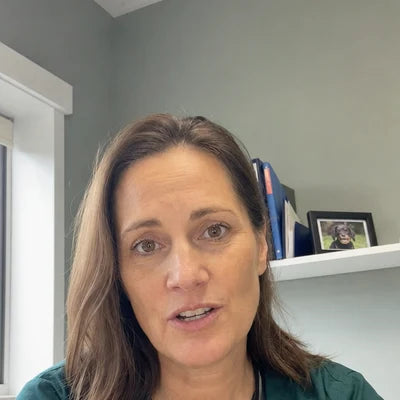
If your dog gets stiffer every morning, you've probably already tried everything.
Painkillers. Green-lipped mussel. Glucosamine. MSM. Devil's claw.
And if he still barely gets on his feet every morning, stops at the stairs or wants to turn back earlier and earlier on walks, you're in the same place as thousands of dog owners.
I've treated dogs with exactly this problem for over 14 years.
And I have to tell you something I only truly understood myself quite recently:
Most treatments for joint problems only suppress the pain.
They don't repair anything.
They don't rebuild anything.
And that's exactly why it still gets worse every month.
At first you barely notice.
Your dog gets up a little more slowly in the morning. Needs a few steps before he's warmed up.
You think: he's just getting older.
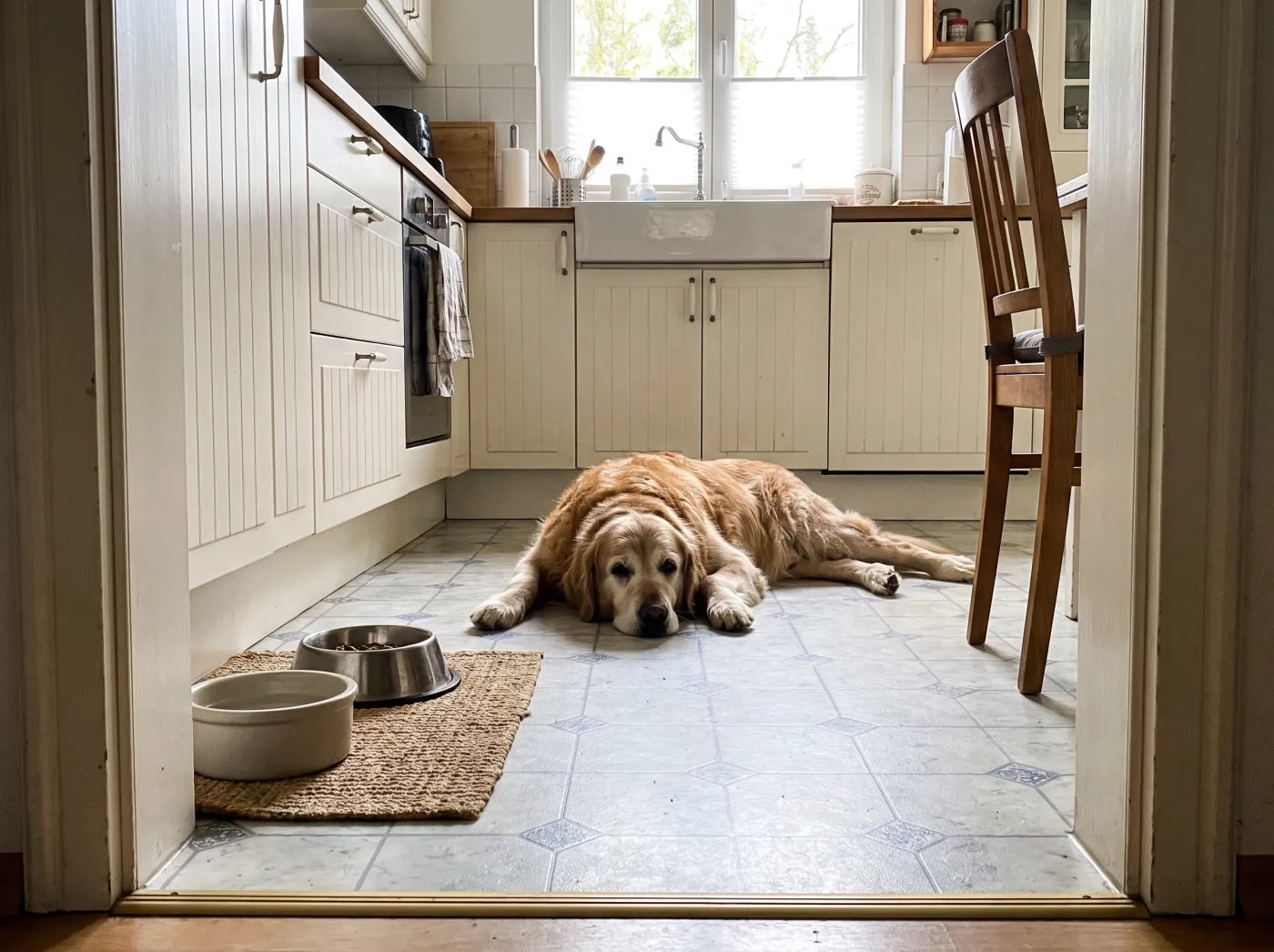
Then it gets worse.
He hesitates at the stairs. Stops at the bottom and looks up.
At some point he doesn't dare go up alone any more.
The walks get shorter. First 60 minutes. Then 40. Then 20.
Even though he still wants to. But his body can't any more.
So off to the vet. An anti-inflammatory. At first it helps. Your dog moves better.
You breathe a sigh of relief.
Three months later the stiffness is back. Worse than before.
So you add something else. Green-lipped mussel. Glucosamine. Devil's claw. Every day in his food.
Some dogs eat it. Some refuse the powder. Some spit out the tablets.
And even for the ones who eat it: nothing changes.
One dog owner describes it like this on a forum:
For years I tried every supplement going, but I never felt it was doing anything. For a long time I comforted myself with the thought: who knows how bad it would be without it.
From a dog owners' forum
Another writes:
By now we've been through almost every painkiller there is. Three different anti-inflammatories. Nothing is really helping at the moment.
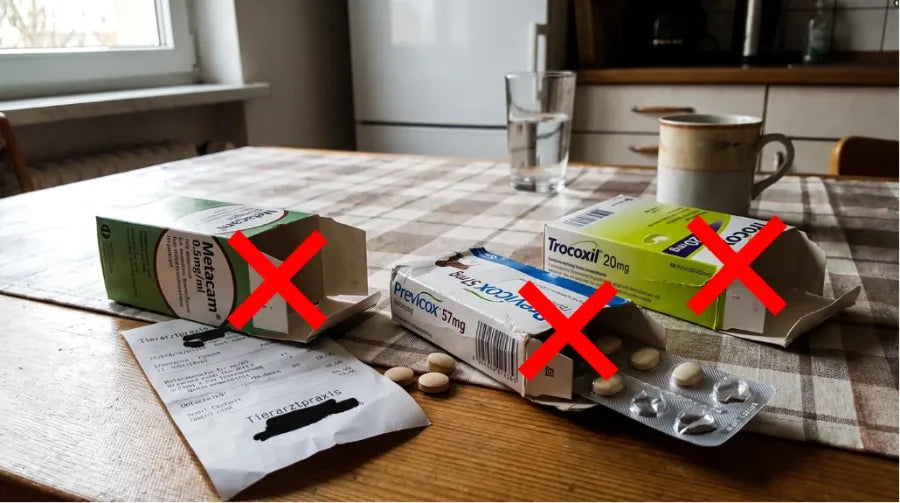
From a dog owners' forum
More and more money. More and more products.
Less and less effect.
And your dog still gets stiffer every day.
Carlo was a 9-year-old Labrador.
His owner Claire did everything right.
Painkillers from the vet. Green-lipped mussel. Glucosamine. Then an expensive combination product from the pharmacy. All of it regularly. Every day.
And Carlo still got stiffer every morning.
Eventually he gave up on the stairs completely. Claire had to lift him into the car.
His walks had shrunk to 15 minutes.
And at night you could hear him. That slipping, when he tried to get up and his claws slid across the tiles.
He was losing more and more muscle in his back legs.
From behind, he looked like a different dog.
I prescribed stronger painkillers. Better for a while. Then worse again.
We switched. First green-lipped mussel. Then glucosamine. Then a combination product.
No change.
Claire sat in my consulting room and cried.
I had no answer.
And I couldn't let it go.
I couldn't sleep.
I kept thinking about Carlo. About all the dogs like him I'd seen in 14 years.
Why did nothing help for long?
At 2am I sat at my desk and started reading studies. Not treatment guidelines. Real research on cartilage and joints.

I read until morning.
And what I found changed everything.
We'd been looking in the wrong place the whole time.
It isn't old age.
It isn't “the breed is just prone to it”.
The real cause is something happening inside your dog's joints. Every day. Without you seeing it.
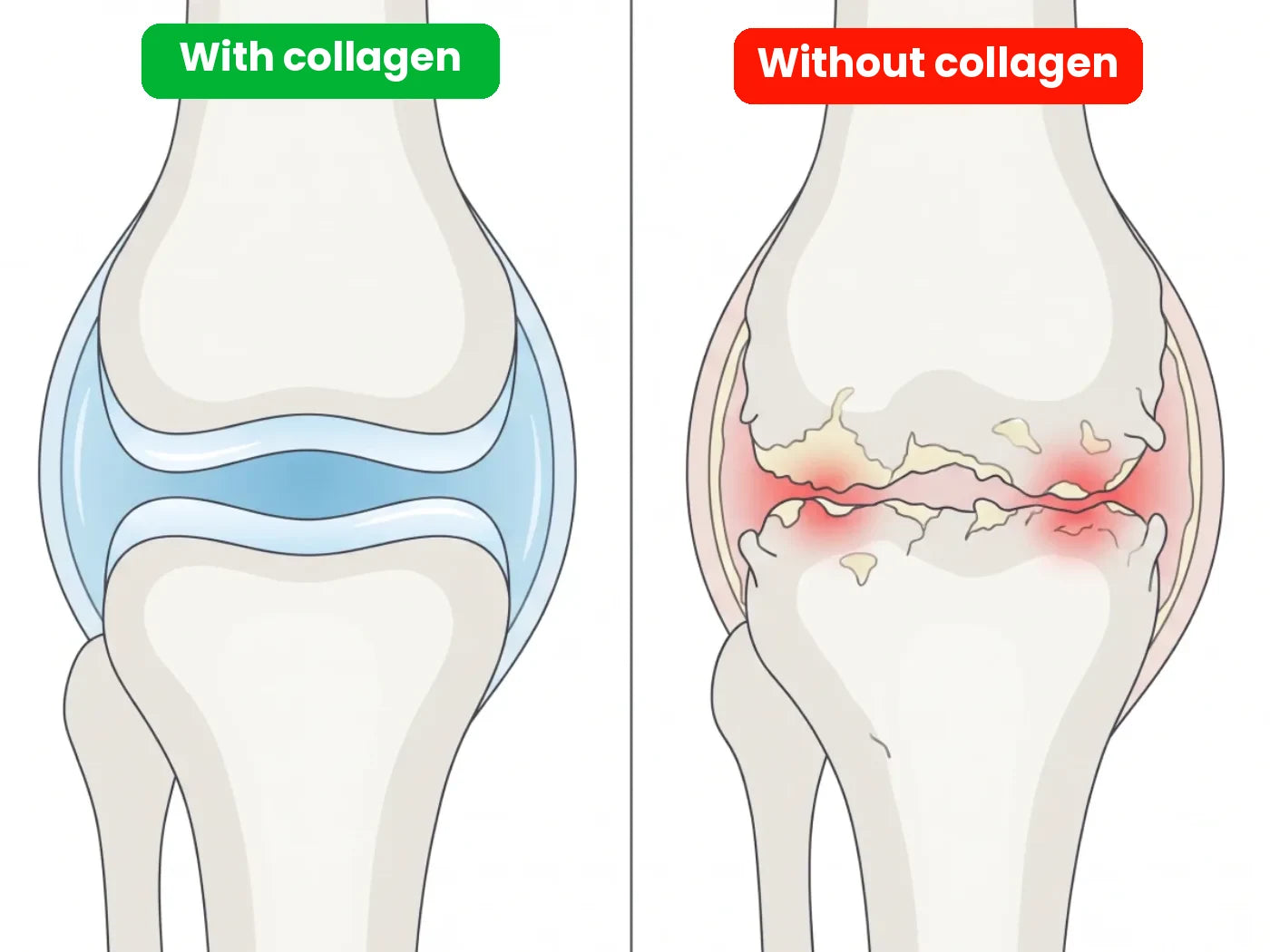
Every joint has a protective layer. A cushion between the bones. That's the cartilage.
As long as the cartilage is intact, the bones glide past each other smoothly. Every step runs cleanly.
No pain. No stiffness.
But cartilage has no blood supply. It doesn't get nutrients through the blood.
It feeds only on the joint fluid around it.
And the most important building block in that fluid is collagen.
Young dogs make enough of it themselves. The tiny tears that happen on every walk, every jump, every staircase get repaired.
The cartilage maintains itself.
But from around 3 to 4 years old, production slows down.
Every year, less collagen is made.
At the same time, modern dog food contains no collagen. No cartilage, no connective tissue.
Just muscle meat, grains, additives.
The natural source of collagen has disappeared from the bowl completely.
Less production from the inside. No supply from the outside.
The cartilage no longer gets what it needs.
Every year it gets thinner. Unnoticeably at first. Then you can feel it.
And at some point it has worn down so far that bone rubs on bone.
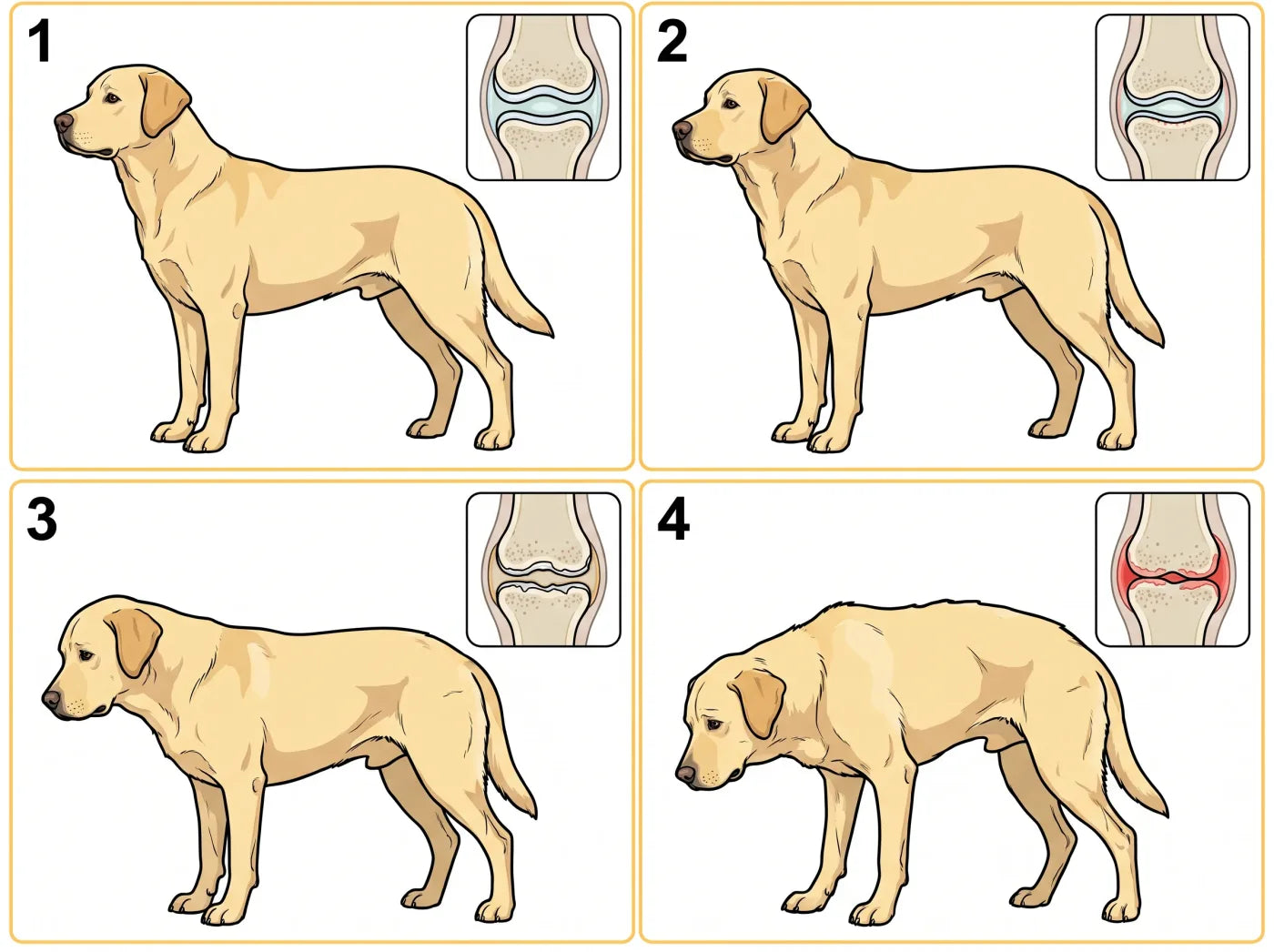
That's the morning stiffness.
The hesitation at the stairs.
The shorter walks.
The pain when he gets up.
All the same thing. Cartilage that is starving.
And now comes the part that explains everything.
Painkillers push the pain down. That works. At first, it works really well.
But they don't repair the cartilage.
It gets thinner every day. The bones move closer together. The friction increases.
That's why painkillers eventually stop working as well as they did at the start.
Not because the medicine gets worse.
But because the damage underneath gets bigger.
So a higher dose. A stronger drug.
Then comes the fear of side effects. Liver values. Kidney values.
One owner writes on a forum:
We want to avoid painkillers for as long as possible, because many of them are processed by the organs.
From a dog owners' forum
Another:
The painkillers made his kidneys start to fail. We let him go.

From a dog owners' forum
Painkillers switch off the alarm. But the fire keeps burning.
They were never built to repair cartilage.
I held every treatment I know up against this finding.
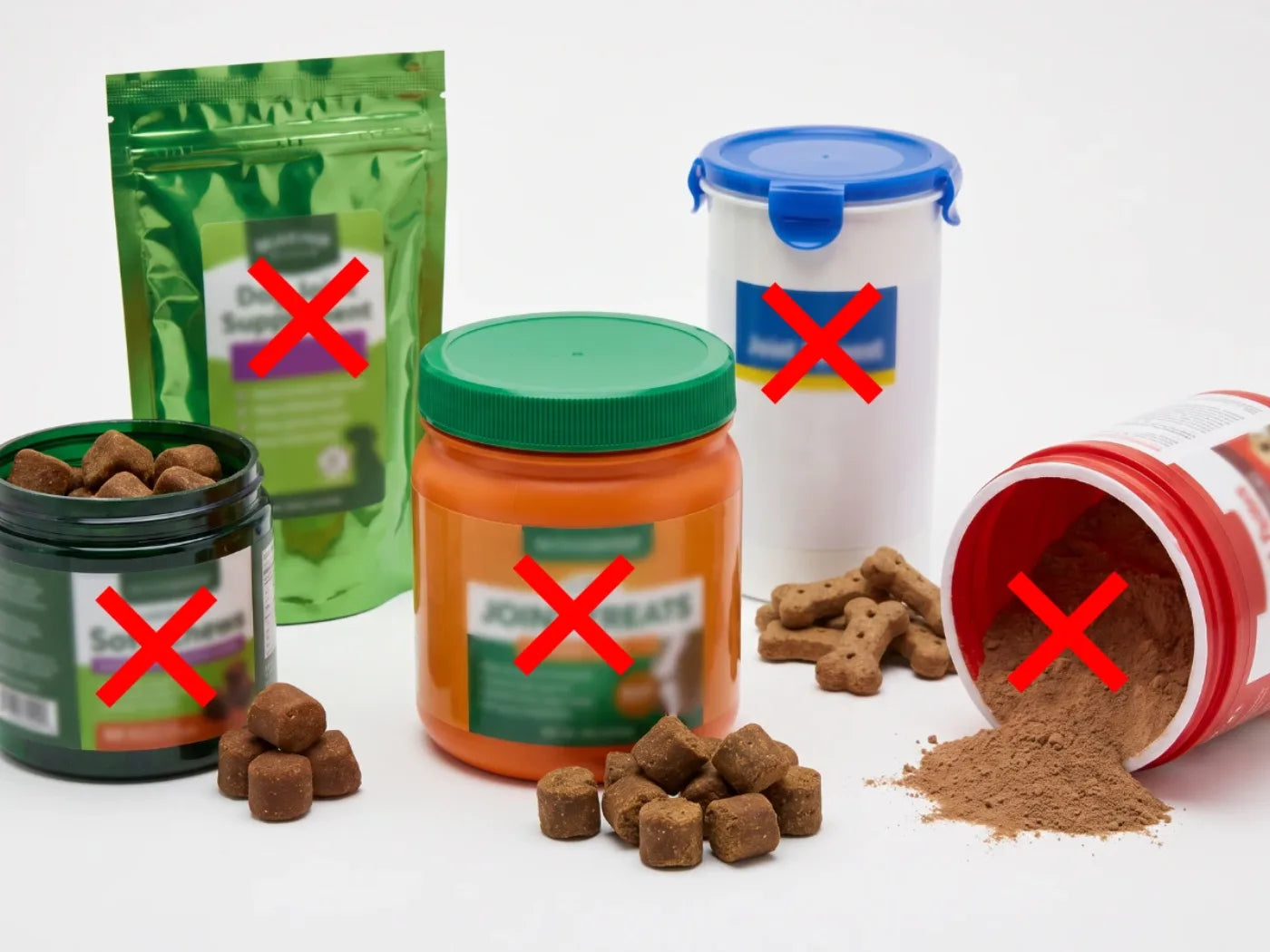
Green-lipped mussel? Provides omega-3 and glycosaminoglycans. Useful. But no collagen.
Glucosamine? Supports the joint fluid. But the main building block of cartilage is missing.
MSM? Calms inflammation. Important. But it doesn't repair cartilage.
Devil's claw? Relieves pain with a plant-based ingredient. But gives the cartilage not a single building block.
They all miss the same point: the cartilage is missing its main building block. Collagen.
The answer isn't another medicine.
It's much simpler than that.
All this time we'd only been treating the symptoms. Instead of the breakdown of the cartilage itself.
Collagen isn't a medicine. It doesn't suppress anything.
It's the building block your dog's cartilage is made of.
When you supply it, the body can repair its own cartilage again.
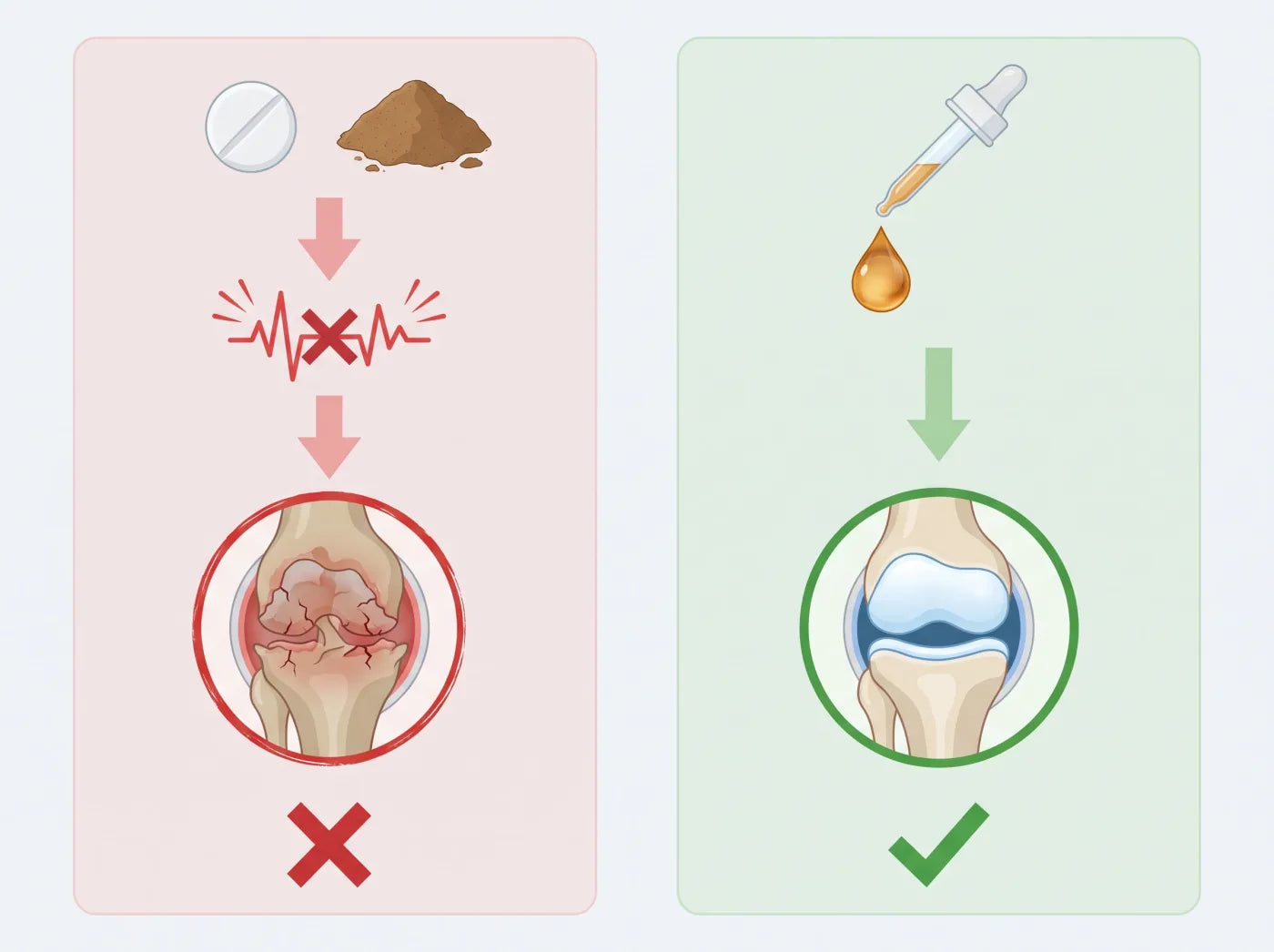
The protective layer gets thicker. The bones no longer rub directly against each other.
The pain eases. Not because it's suppressed. But because the cause gets smaller.
That's the difference between covering a problem up and fixing it.
Cartilage needs three types of collagen to repair itself.
Type I is the foundation. The framework that gives cartilage its structure and strength.
Without Type I there's no stable cartilage.
Type II is the most important. Over 90 per cent of joint cartilage is made of it.
It keeps the cartilage elastic and absorbs impact.
Clinical studies in dogs have shown that exactly this type measurably improves mobility.
Type III repairs the tissue around the joint. Tendons, ligaments, everything that holds the joint together and keeps it stable.
If one of the three is missing, the repair stays incomplete.
Then there's hyaluronic acid. It makes the joint fluid thick and smooth again. So the bones glide instead of rubbing.
And MSM, which calms inflammation in the joint. Until the cartilage is fully repaired, the inflammation underneath has to be kept in check.
But all of this only works if it actually arrives.
Chews and powders are made with heat. That destroys a large part of the collagen. What's left is broken down further in the stomach. In a dog, almost none of it reaches the cartilage.
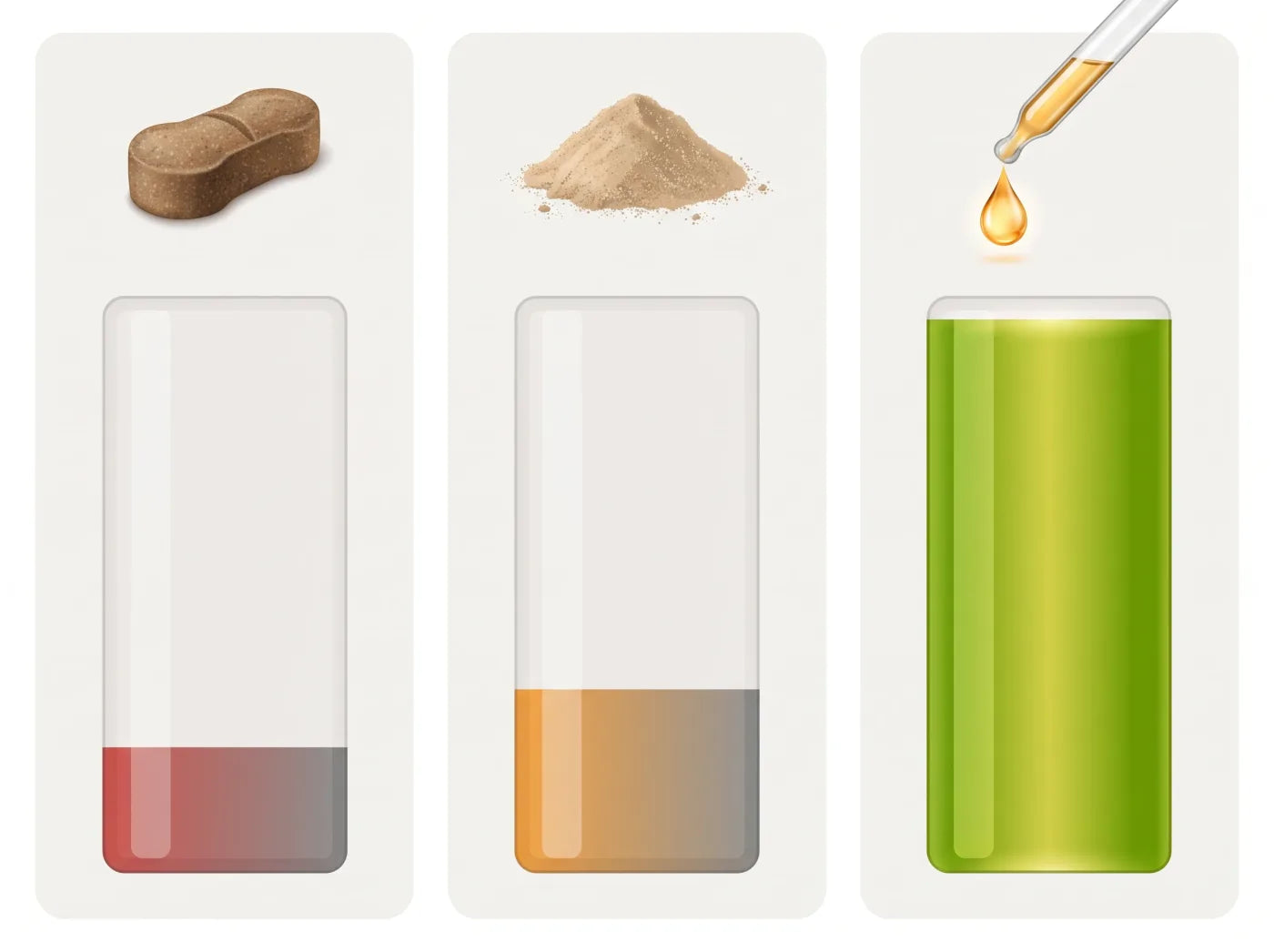
Liquid is different. Liquid collagen is split into tiny pieces and absorbed directly. 99% reaches the joint.
That was what mattered to me. A formula that contains everything the cartilage needs. In a form that actually gets there.
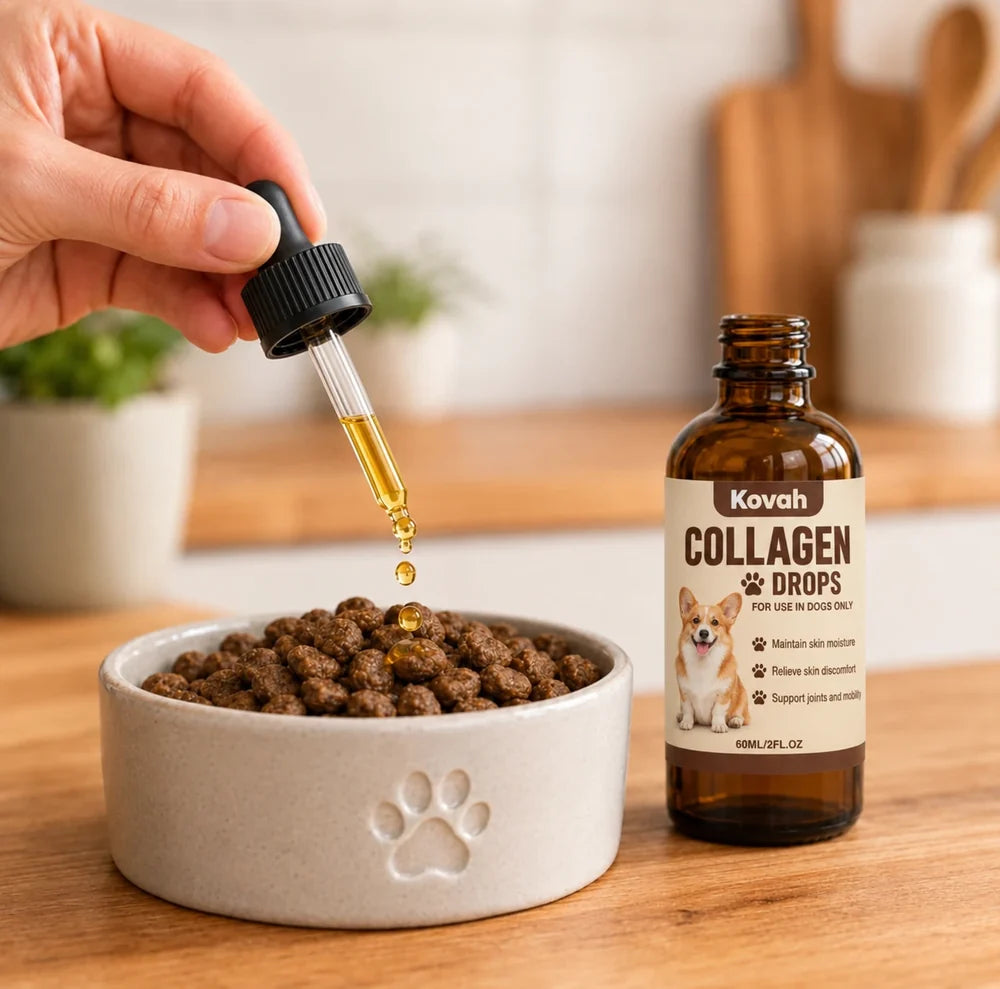
I worked with Kovah on exactly this formula: Kovah Collagen Drops.
Once a day with the pipette over his food. Your dog doesn't notice. Ten seconds, done.
Because I want as many dogs as possible to benefit, I've arranged an exclusive discount with Kovah for everyone reading this article: right now you get up to 40% off your order.
But I have to say one thing: the drops are made in small batches, because liquid collagen can't be mass-produced like cheap chews. When a batch runs out, there's a wait for the next one.
90-day money-back guarantee.
If nothing changes within 90 days, you get your money back. No questions asked.
If you want to try it, I wouldn't wait too long.
I told Claire: give him the drops over his food every morning. Don't stop anything. Just add them.
The first 2 weeks: Nothing visible. I'd warned Claire it takes time. Cartilage doesn't rebuild overnight.
Week 3: Claire wrote to me.
“He gets up more easily in the morning. Not by much. But I don't have to help him any more.”
Week 4: Carlo walked up the stairs. Without hesitating. Just like that.
For the first time in over a year.
Claire sent me a video:
Week 6: The walks got longer. First 20 minutes. Then 30. Then 40.
Claire didn't have to carry him home any more.
Month 2: Carlo climbed back onto the sofa for the first time. On his own.
Claire wrote to me:
“I cried. I thought I'd never see that again.”
Month 3: Together with her vet, Claire reduced the painkillers. Half the dose. Then stopped.
No relapse.
Month 4: Carlo gets the drops over his food once a day. Nothing else.
He gets up in the morning as if nothing had ever happened. He takes the stairs on his own.
He doesn't jump into the car any more. But he puts his front paws up and only needs a little push.
He isn't 3 again. But he's himself again.
Claire wrote to me:
“I've got my dog back.” — Claire, Carlo's owner

“Tried 3 different things in 2 years. Green-lipped mussel, glucosamine, an expensive powder from the vet. Nothing did anything. Since the drops he gets up in the morning as if he'd never had a problem.”

“Our German Shepherd is 10. His walks had shrunk to 15 minutes. After 4 weeks on the drops we're back to half an hour. He's so happy he does little hops.”

“We were sceptical. We'd already spent so much money on all sorts of things. But the drops are the first thing where we really see a difference. The painkillers have stayed in the cupboard for 6 weeks.”
Since Carlo's story, I haven't been able to let this go.
I recommend Kovah Collagen Drops to my clients.
It's the only liquid formula I know that contains all three types of collagen.
Plus everything else the cartilage needs: calming inflammation, improving the joint fluid, repairing tissue.
Once a day over food. Alongside everything your dog is getting now.
Don't stop anything. Just add it.
Right now there's up to 40% off your order.
Plus a 90-day money-back guarantee. If nothing changes, you get your money back.
PS: If your dog is only just starting to get stiffer in the mornings, you're in the best possible position.
The cartilage hasn't worn down far yet. Start now.
Before the stairs become a problem. Before the walks keep getting shorter. Before you have to lift him into the car.
For your dog's health,
Dr. Helen Chambers
Veterinary surgeon, 14 years in small-animal practice
Note: joint problems should always be checked by a vet. Kovah Collagen Drops is a complementary feed and not a substitute for veterinary treatment. Results may vary.